
In today’s AI-accelerated landscape, the role of a marketing leader is evolving rapidly. At Kovai.co, where multiple enterprise products and global teams converge, marketing is both a growth engine and a strategic function.
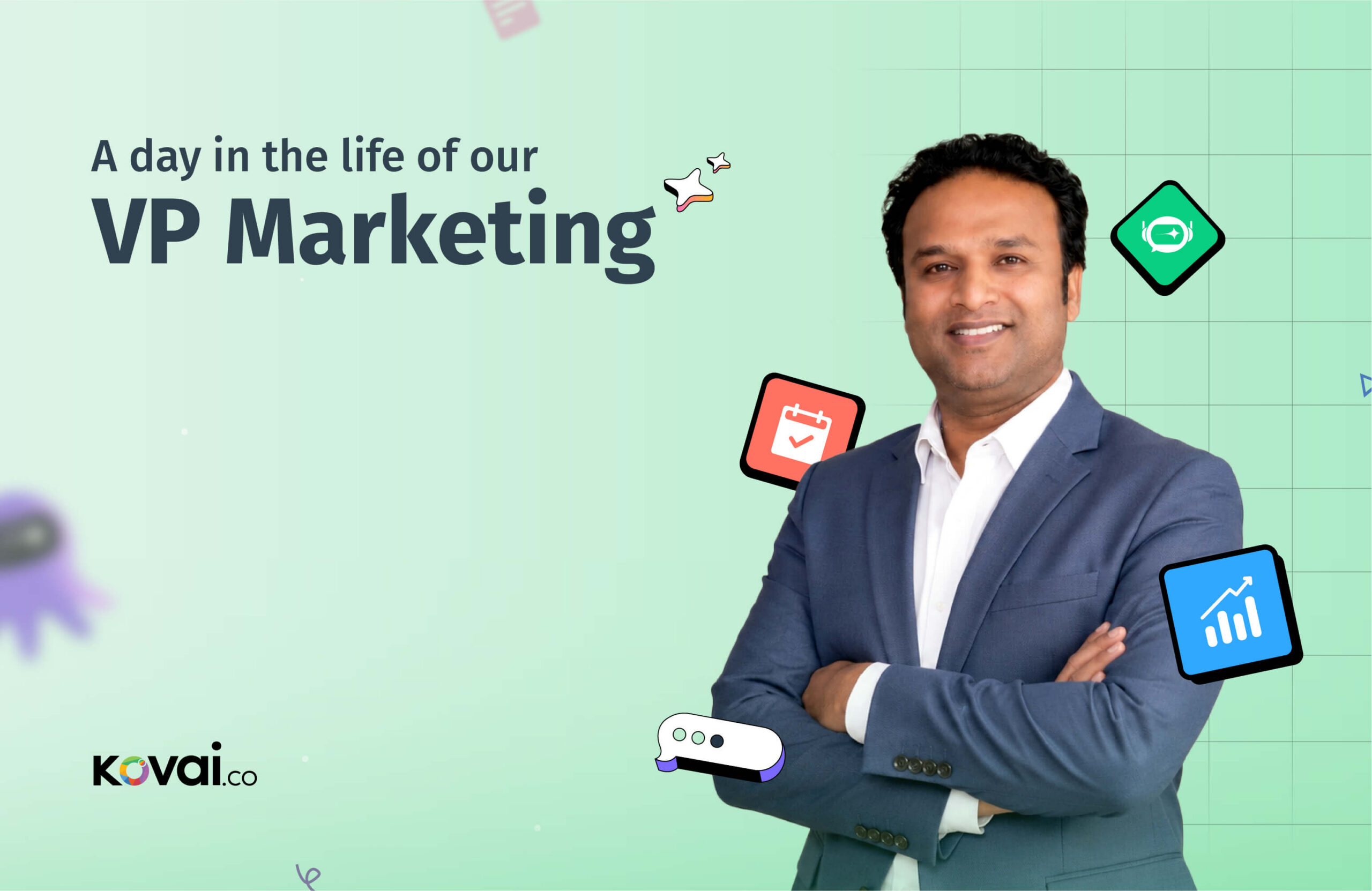
Sunil Pillai, our Vice President of Marketing at Kovai.co, leads this transformation, shaping AI-driven marketing systems, guiding multi-product positioning, and aligning global teams toward growth. But behind the titles and strategy decks is a leadership style grounded in clarity, structure, and balance.
We sat down with Sunil to walk through his typical day.
Phone-free start
Quiet time before the world begins.
Calendar review
Understanding what the day needs first.
1:1s with the team
The overlap window, used deliberately.
Cross-functional catch-ups
Connecting dots before they drift apart.
Strategic conversations
Clarity comes from talking it through.
AI-assisted deep work
Days of work, done in minutes.
Focus filter
Not everything urgent moves things forward.
Hard stop
Structure makes switching off easier.
Starting the day
My day starts in London.
I usually wake up around 6 am. Not too early, not too late. I’m not a morning person or a night owl, I just try to get good sleep.
The first 30 minutes of my day are quiet. No phone, no emails. That helps me start with a clear head instead of reacting to things immediately.
After that, I look at my calendar. I try to understand what the day needs from me: decisions, conversations, or just time to think.

How I think about work
I work roughly from 9 to 5. I don’t believe in stretching hours unnecessarily.
Productivity is not about working longer. It’s about managing your energy.
If I push too much one day, it affects the next. So I try to stay consistent.
I plan my day, but I also leave room to adjust. Plans are useful, but flexibility matters just as much. Some of the most important conversations are the ones you don’t plan for.
Most of my day is conversations
My day usually starts with calls. Since I’m based in London and a large part of the team is in India, mornings are when most of my 1:1s and team catch-ups happen. That overlap window is limited, so I try to use it well.
A lot of this time goes into conversations with direct reports – what they’re working on, where they’re stuck, and what needs a decision. Alongside that, there are cross-functional discussions with product, sales, and growth teams.

In a multi-product setup, things are rarely isolated. A small change in positioning can affect sales conversations the same day. A product update can shift how we communicate value. So a big part of my role is connecting these dots early.
When the day goes well, it’s usually because something moved forward.
A decision got unblocked, a direction became clearer, or someone left a conversation knowing exactly what to do next.
I try to keep my calendar structured so these conversations have space, but not so packed that there’s no room to respond to something unexpected. Because beyond scheduled meetings, a lot of alignment happens in between, quick calls, messages, or stepping in before something becomes a bigger issue.
Choosing what to focus on
With multiple products, there’s always more to do. So, I focus on things that scale systems, positioning, and long-term growth.
“The challenge is not time. It’s focus.”
It’s easy to get pulled into one-off activities – a campaign tweak, a last-minute request, a quick review. Some of them matter, but many don’t move things forward in a meaningful way. I try to spend more time on work that compounds building repeatable systems, refining positioning, or improving how teams operate.
I don’t usually sit alone and think through strategy for long hours. Most of the time, clarity comes through conversations.
When something is complex, I talk it through. Even explaining the problem helps.
I often discuss things with our CEO or the leadership team. It speeds up decision-making and avoids overthinking.
Using AI in everyday work
AI is now part of almost everything I do. Research, writing, positioning, and analysis all move faster with AI. What used to take a couple of days, like exploring a new market angle or drafting multiple positioning options, can now be done in a fraction of the time.
“Tasks that took days can now be explored in minutes.”
But for me, AI is not just about speed. It’s changing how we approach work. We’re moving towards AI-native marketing.

That means thinking in terms of systems, how research feeds into content, how content feeds into campaigns, and how everything can be improved continuously. I also encourage my teams to experiment actively. Not every tool or workflow works, but that’s part of the process. Things are changing fast. So I try different tools regularly, not everything sticks, but some become part of how I work.
My personal workflow
I keep my system simple. I use voice a lot to capture ideas, reminders, or quick thoughts, usually in between meetings or while switching contexts. Those notes get organised automatically, so I don’t have to come back and sort them later.
The goal is not to use more tools. It’s to have fewer systems that you actually trust.
If a system feels heavy, I won’t use it consistently. So I try to keep things minimal and reliable.
Outside of work, the pace is very different. I play badminton a couple of times a week. It helps reset both physically and mentally.
Weekends are usually slower, time with family, some sport, and community involvement. It’s a different rhythm, but it matters just as much.
Switching off
I try to keep a clear boundary between work and personal time.
“When your day is structured, it’s easier to switch off.”
That separation helps me come back the next day with a clear head.
That’s my day
There’s no fixed template. Some days are more intense, some are lighter.
But overall, I try to keep things simple – focus on what matters, stay consistent, and leave space to think.
If there’s one thing that’s worked for me, it’s this:
Clarity doesn’t happen by chance. It comes from how you structure your day.
And if this gives you a reason to rethink your own day even slightly, that’s a good place to start.
I share more stories and lessons from the documentation space through my series.
Check out the series – Inside Great Documentation.
Sunil’s working principles
- First 30 minutes: no phone, no email, protect the starting headspace
- Use the India–London overlap window deliberately; it’s limited and valuable
- Clarity comes through conversation, not solo thinking marathons
- AI isn’t just speed, it’s a shift in how the entire marketing system is designed
- Fewer tools you actually trust beats more tools you don’t use consistently
