
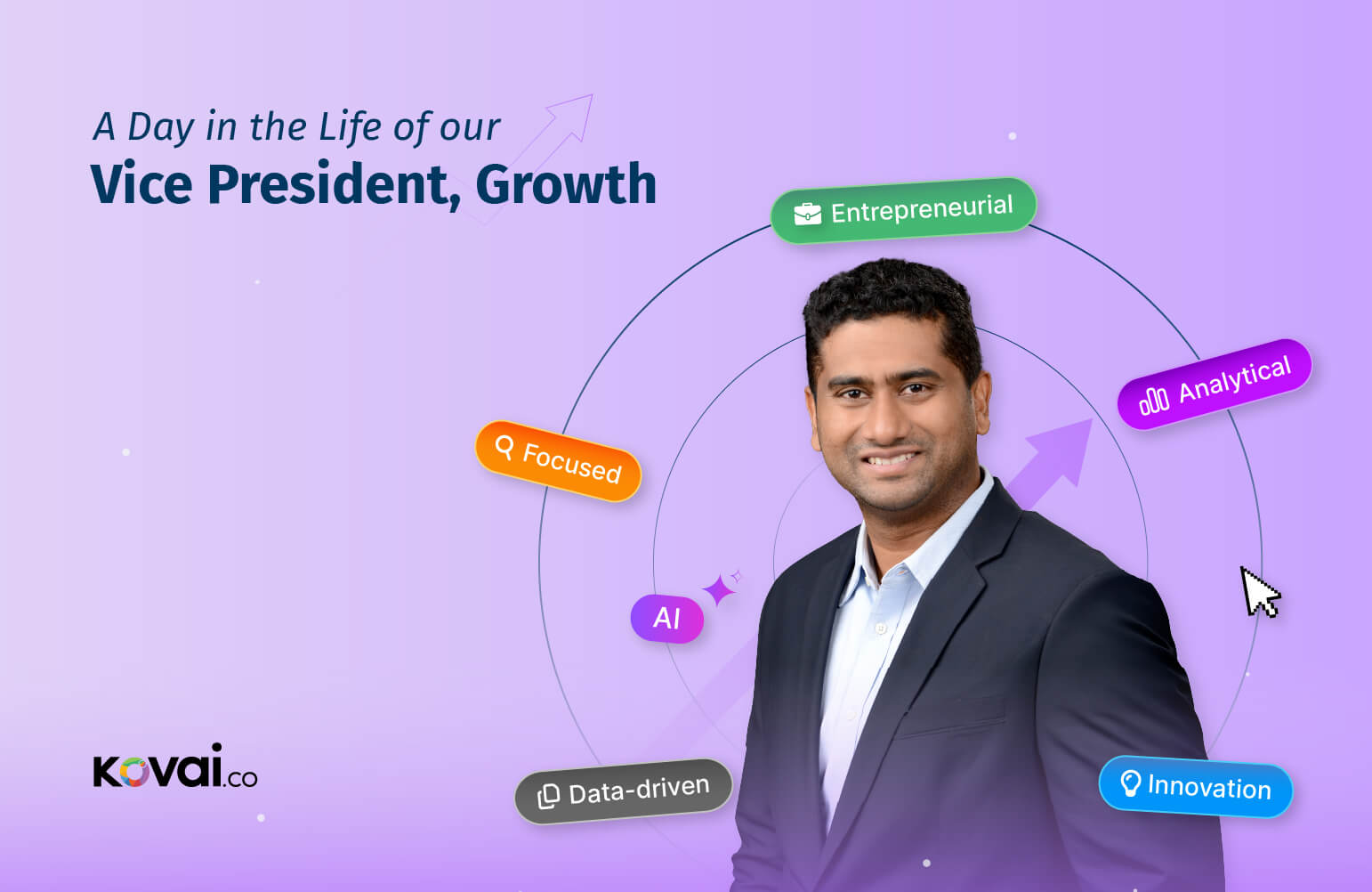
As VP, Growth at Kovai.co, Suprej Venkat’s role moves across revenue, customers, teams, strategy, and data. His day is not built around doing more things at once. In fact, it is quite the opposite.
He protects time to think, focuses on one major initiative at a time, and makes room for customers and colleagues when they need him.
We sat down with Suprej to understand what a typical day looks like for him.
Suprej’s typical day
Gym
The part of the day that has been non-negotiable for 10 years.
Thinking and planning
Monday and Friday mornings are kept free of meetings.
Internal meetings
Outbound, customer success, account management, and leadership conversations.
Tennis
When there is no meeting at that hour.
Customers and prospects
Calls with people in the UK and US shape the later part of the day.
Internal meetings are in the afternoon Indian time. Customers and prospects are after 19:30. Morning belongs to me.
My mornings are for thinking, not meetings
I am protective of my thinking time, so Monday and Friday mornings have no meetings. That is when I think and plan. Every day, I start by clearing messages and emails. What I work on changes from week to week depending on the initiative.
Some of my clearest thinking has happened on a motorcycle.

Focusing on One Initiative
I deliberately run one deep initiative at a time, usually in a two- to three-week block, and give it everything until it is done.
I have tried running three in parallel, and all you get is three half-finished things.
So I would rather go narrow, finish it, hand it over, and pick up the next one.
That also means the work I focus on can change quite quickly, but the approach stays the same. Context switching is still genuinely hard. But many of the ad hoc meetings I deal with are customer issues, and those are time-sensitive. So sometimes you have to stop what you are doing and come back to it later.
Putting People First
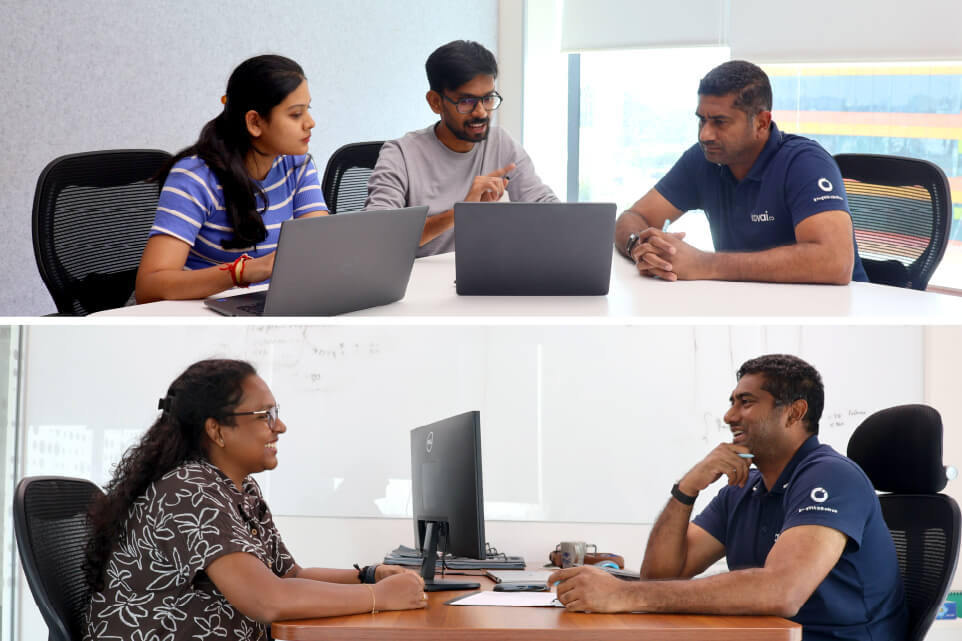
My job is to unblock the leaders who report to me. If I take two days to respond, that is two days lost for their entire team, not just mine.
The same applies to prospects. If a prospect is waiting on me, I will park whatever I am doing.
The Metrics That Matter
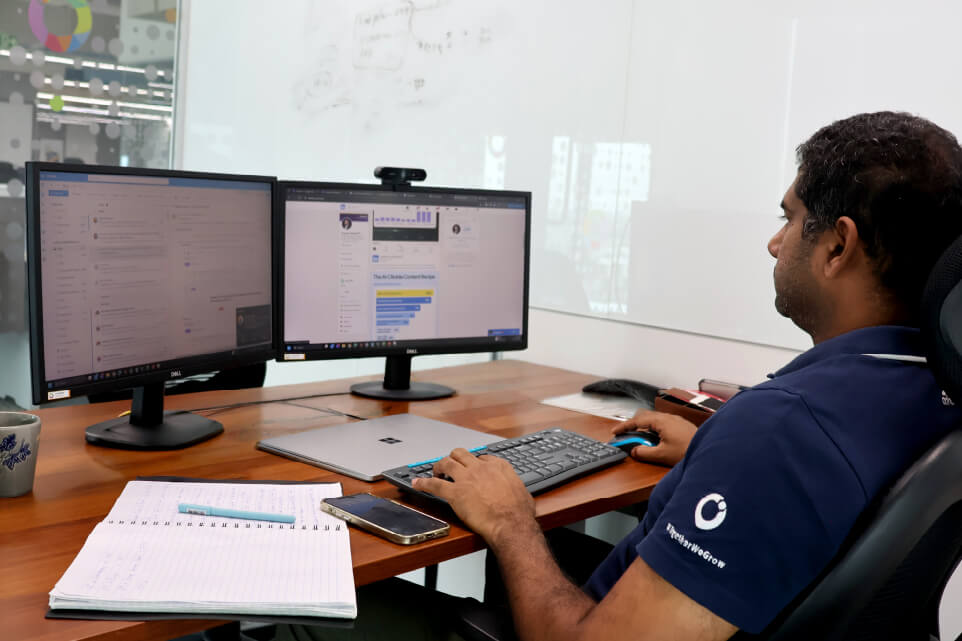
I am heavily data-driven, so I spend a lot of time in dashboards.
I look at churn forecast, account management pipeline, MRR and trajectory, SDR metrics such as meetings booked and held, SQLs, deal movement week on week, and projections.
But the metric I trust most as a leading indicator is meetings held rather than meetings booked. Booked tells me the SDR did their job. Held tells me whether the prospect actually cared. The gap between those two numbers tells me more about targeting quality than almost anything else.
Booked is a vanity number. Held tells you whether the prospect actually cared.
Data, Intuition, and Experience
When I have to make a difficult growth decision, I start with data. Always.
But data only tells you what has already happened. It does not tell you what happens next, and in a market moving this fast, the past is a shorter guide than it used to be.
So data narrows it down, and 23 years of doing this helps decide between what is left.
I would put it roughly at 70% data and 30% intuition. The 30% is where the hard calls live.
We once had a segment that looked healthy on usage and retention. Everything said we should keep investing there. My instinct was that those customers were never going to expand because they had hit their ceiling. That turned out to be right.
Not because I had better data. It was because I had sat in enough of those calls to know what a ceiling sounds like.
That is the part you cannot get from a dashboard, and it is also the part you should be most sceptical of in yourself.
What Growth Means in SaaS
A common misconception about growth in SaaS is that it is mainly an acquisition problem.
More leads. More spend. More demos. More customers.
But if you double acquisition while your NRR sits at 90%, you are just filling a leaky bucket faster.
For me, growth is the balance of three things: new acquisition, retention, and expansion into the base.
The second and third are harder to move and get a fraction of the attention because acquisition is more visible and easier to celebrate.
People also tend to see growth as a marketing career path. But the role requires working across marketing, product, and sales, and understanding the macroeconomics of the market you operate in.
I also think being an entrepreneur is better preparation for a VP of Growth role than simply being a marketer. You need to have worked across marketing, product, and sales, and understand the macroeconomics of the market you operate in.
In practice, it is closer to running a small business inside a bigger one.
Working with AI
AI has collapsed what one person can build. When we built Churn360, it took a team of 30 and two years.
Over the past year, I have built Nexus, our internal customer success platform, largely on my own in the gaps in my calendar. It brings together Chargebee, Freshdesk, our NPS data, and SSO, and it is what our CS team actually runs on day to day.
It is not a bigger product than Churn360, but it fits how we work far better. The more interesting change for me is what AI is doing to our category. Organic search is being absorbed by AI answers. That changes how a knowledge base product gets discovered and also what a knowledge base is for.
When your documentation is being read by a machine before it is read by a human, that is a different product problem.
That is what I spend the most time thinking about right now, rather than whether AI helps me write faster.
The Tools I Use
We are a Microsoft shop, so I use Teams heavily. I use Claude Code for the projects I build and maintain, and ChatGPT for general work.
But I still prefer a notebook.
I usually work from a written list and keep ticking things off as I work through it. I prefer it over digital, and the notebook travels with me.
How I Approach Decisions
Most decisions are reversible, and for those, the cost of being slow is higher than the cost of being wrong. So I make them fast.
A few are hard to reverse, such as a senior hire or a change in positioning. For those, I slow down and deliberately list every reason I should not do it.
That stress-tests the decision, and by the time I take it to the board, I have already pre-empted most of the pushback.
Building Momentum Through Small Wins
The part of my job that gives me the most energy is watching something I planned get executed by the team and actually work.
Small wins that compound keep people going far better than one big bet that may or may not land.
That is why I break things into incremental steps. I want the team to see results early and often rather than wait six months for a verdict.
Suprej’s Working Principles
- Focus on one deep initiative at a time rather than splitting attention across several half-finished things.
- Put people first when a colleague, customer, or prospect is blocked waiting for you.
- Look at meetings held, not just meetings booked, to understand whether prospects actually care.
- Use data to narrow decisions, then use experience to decide what happens next.
- Think about growth through acquisition, retention, and expansion—not acquisition alone.
- Move quickly on reversible decisions and slow down when a decision is difficult to reverse.
- Break work into incremental steps so teams can see results early and often.
Want to know how other leaders spend their day? Explore our “Day in the Life” series featuring our VP of Sales, COO, VP of Marketing, and more.
